
In the 1920’s, the world was upended by the subatomic reality of quantum physics. During this timeframe physicists like Werner Heisenberg and Erwin Schrödinger discovered equations and wave functions that uncovered the unpredictable behavior of subatomic particles. Specifically, Heisenberg’s “Uncertainty Principle” stated that it is impossible to know both the velocity and position of a particle at the same time. This insight allowed Schrodinger to develop an equation for finding the probable location of an electron rather than a specific location.
Their work showed that the motion of particles at the quantum level could only be predicted in terms of probabilities and that nothing could be known with certainty until the exact moment the particle is observed. Even stranger, this also inferred that this certainty was dependent upon our intervention. These insights blew the doors off classic physics, undermined our assumptions about space and distance, and inferred that we are interconnected at quantum levels.
Aside from this ground breaking work, Schrödinger is also known for a quirky thought experiment (“Schrödinger’s cat”) that was imagined to show the absurdity of various interpretations of quantum mechanics. The crazy thing is, much of the world took it seriously and expanded their interpretations (i.e., many worlds interpretation). Ultimately, this thought experiment became famous for illustrating (albeit, incorrectly) a foundational characteristic of quantum theory – indeterminacy.
From an astrological perspective, indeterminacy is an expression of the planet Neptune. This planet tends to “blur the lines” on what is real. It symbolizes confusion and uncertainty. It can represent other realities that exist beyond the standard physical reality we can observe with the naked eye. Most significantly, Neptune represents the unity or connection of all things. It is an apt symbol for quantum physics itself. Interestingly enough, this planet holds a prominent position within the natal charts of both physicists as well.
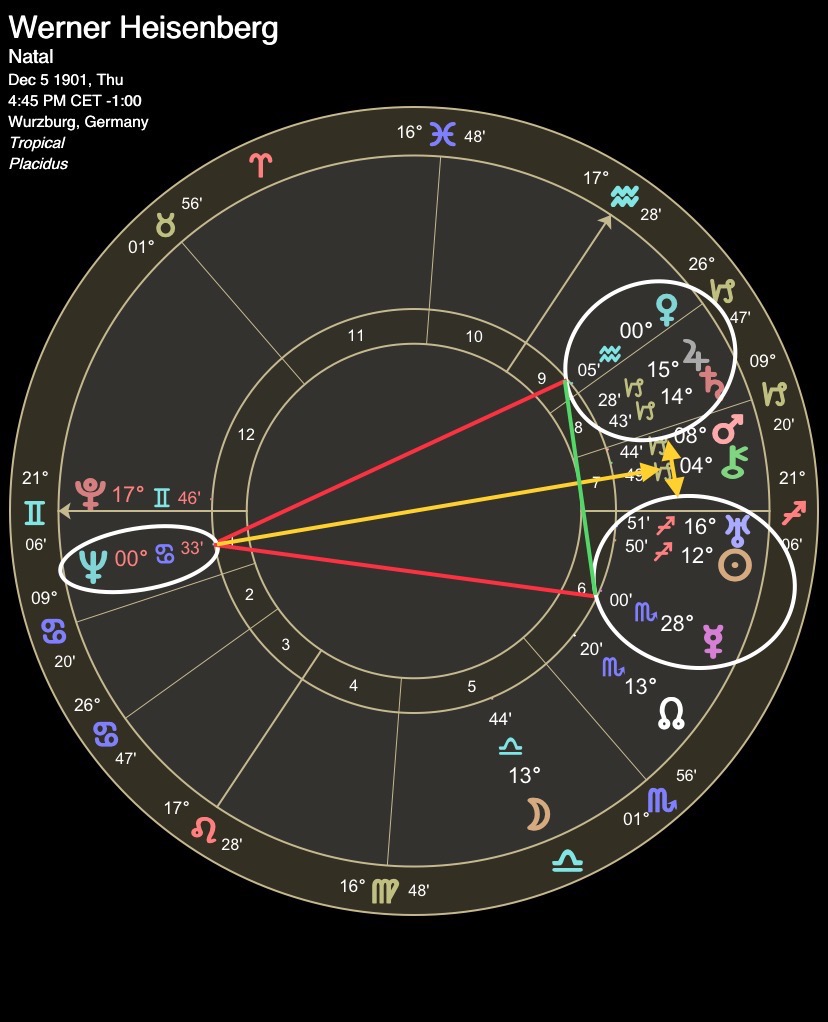

With Heisenberg, Neptune is placed in the 1st house of identity. This makes sense because his name became synonymous with the “uncertainty principle” that he discovered in relation to the behavior of subatomic particles. Additionally, this Neptune is at the apex of a Yod configuration involving Venus and Mercury. This adds more emphasis to Neptune’s expression, but also ties it closer to Heisenberg’s identity since Mercury was the ruler of his 1st house. Finally, Neptune is in opposition to the midpoint of Jupiter, Saturn, Uranus, and the Sun. So, if we include the Yod (which is basically a midpoint as well), Neptune opposes the midpoint of six planetary bodies, over half the chart! Based upon these alignments, Heisenberg was not just studying Neptune and quantum mechanics. He WAS these dynamics.
As impossible as it may sound, Neptune’s synchronicity within Erwin Schrödinger’s untimed natal chart is even more ridiculous. Here, Neptune is anaretic. By degree, this is a unique position for a planetary body. Planets that are anaretic are placed at the 29th degree of a sign. As you can imagine, there are many different opinions on how these manifests. Some astrologers view it as a “fated” placement in that they sense the inevitability of the end of a cycle. Some see it as the “peak” expression of a planet before it changes signs. Others define this placement as debilitating and affects the planet’s decision-making ability. Then there are others who think the anaretic quality gives a planet “experience,” a benefit from its journey through the rest of the sign. To a certain extent, I think all these perspectives are useful in evaluating the “critical” nature of an anaretic placement.
With that said, it should be noted that anaretic placements for outer planets tend to be less significant. These planets move so slowly that this degree is shared by a generation of individuals. This was not the case for Schrödinger. His Neptune was not only anaretic, but also FOUR days from changing signs from Taurus to Gemini. Also, his Moon was within vicinity of conjunction and Neptune’s dispositor (Venus) was in tight trine aspect. This “personalizes” what Neptune represents for Schrödinger. As incredible as it may appear, these connections make him a “conduit” for its massive expression at the very end of Taurus. Just how massive was this expression? Well, consider that Schrödinger was born just four years prior to the epochal conjunction between Neptune and Pluto. This cycle is 500 years long. With Neptune’s association with quantum physics and Pluto’s function towards deep and permanent transformation, the impact that quantum physics had on civilization over the past century or so cannot be overstated.
In other words, Schrödinger may be viewed as a type of “harbinger” of the change into the new cycle of Gemini. And, with Gemini’s association with multiplicity, Neptune’s tendency towards uncertainty or lack of definition makes sense when considering the indeterminate behavior of electrons due to positions in multiple locations.
This Gemini theme is expanded further when considering Neptune’s involvement in a midpoint configuration involving Mercury, Saturn, and Chiron. Chiron in Gemini conjoins the midpoint of the structure at less than half a degree, making this the tightest midpoint alignment in the chart. Also, Saturn and Chiron’s placement at anaretic degrees echoes the delineation of Neptune’s anaretic status. In other words, this is an anaretic midpoint picture. It highlights the symbolism of the end of a major cycle (classic physics) that personally centered around Schrödinger.
Chiron in Gemini represents problems with communication and how we perceive information. Gemini is one of the most curious of all the signs in the zodiac so its association with observation is obvious. Saturn deals with reality, structure, and laws. In this chart, we may view it as symbolizing the classic laws of physics built around the reality which we can observe and measure. Neptune, with its archetypal focus on indeterminacy and other realities is a bit of a contradiction to this. Chiron’s tight midpoint here reflects the problem in being able to trust our observations (Chiron) of the structure of reality (Saturn) based upon the uncertainty (Neptune) of the subatomic realm.
Mercury’s dispositorship of Chiron, its out-of-sign conjunction to Saturn as well as the triple-parallel relationship to Chiron and Neptune offers insight. It highlights that the only absolute (fixed placement) information (Chiron dispositor) we can discern about the positions of subatomic particles (Saturn) is the exact moment they are observed (out-of-sign conjunction). Also, Mercury’s connection to this midpoint picture symbolizes that our observations are part of the process while appearing to remain outside of it.

Ultimately, Schrödinger’s chart works as a holistic symbol of quantum physics in its entirety, but both charts are a marvel of synchronicity in their elevation of Neptune’s prominence in correlation to the impact that these physicists had upon quantum physics.
Neptune’s inherent indeterminacy also echoes something else – the multivalence of astrological manifestation. Because planetary archetypes can represent a range of potentialities (similar to quantum probabilities), there is no complete certainty as to how an archetype may manifest.
It is something to ponder in this new world we have entered.
 Electric Storm Astrology