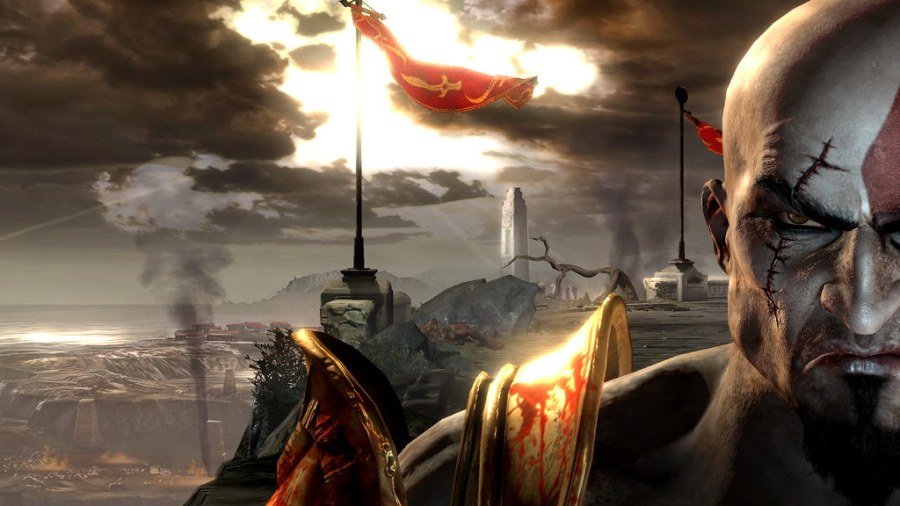
For thousands of years, Mars has been viewed by countless astrologers as a malefic. In modern times its expression has been RE-envisioned as passion, energy, work, courage, and initiative, but Mars can also be anger, hostility, violence, battle…and war. Sometimes it helps to analyze embodiments of a planet’s function at its basest level. For Mars, let us look at one interesting example that is quite surreal and literal – the video game, “God of War.”
Kratos

Originally released in 2005, the “God of War” game series has become one of the most loved franchises in video game history. It became an almost instant success due to its realistic graphics, impressive sound effects, fluid in-game fighting mechanics, but also because of its deep story. With most video games, the story is usually an afterthought or secondary to those other structural components. With “God of War,” the story is an integral component to its popularity…and it is interwoven with ancient mythology.
The story revolves around the character Kratos, a Spartan warrior champion who became famous for his skill and ruthlessness in battle. Kratos’ reputation became so widespread that it attracted the attention of the Spartan’s god, Ares. Ares offered Kratos the opportunity to join his personal army. He agreed and spent many years fighting on behalf of Ares and vanquishing many enemies. Ares was so satisfied with Kratos’ performance that he gifted him special weapons (Blades of Chaos) that were infused with the power of Ares himself.
Unfortunately, Ares was not completely satisfied with Kratos’ loyalty and dedication. To motivate him, he ordered Kratos to attack the temple of his sister, Athena. But before the attack, Ares transported Kratos’ wife and child to that temple. He knew that Kratos’ blood lust in battle was so blinding that he would not recognize them. He was correct and Kratos accidentally killed his wife and child. Afterwards, an oracle cursed Kratos by disfiguring his skin with the ashes of his family, forever turning him white. He became an outcast known as the “Ghost of Sparta.”
When Ares explained to a Kratos what he did and why it did not improve his loyalty. Instead, it emboldened his rage. Because other gods suspected Ares’ desire to overthrow Zeus, they decided to help Kratos in his quest for revenge. Kratos was going to war with Ares. Along the way, he killed many gods and mythical creatures until arriving at the final showdown with Ares and slaying him.
After destroying Ares, Kratos asked the gods to remove his nightmares, the torture of his grief from killing his wife and child. The gods would not fulfill this request so Kratos jumped to his death from the highest peak in Greece. Fortunately, Zeus intervened before Kratos reached earth, saving him, and bringing him to Olympus. There, he promoted Kratos, making him the new God of War.
It is important to understand this story because it is contained within the astrological symbolism of the untimed chart that corresponds to the initial release of the game. Let us tell this story through that symbolism.
The Chart
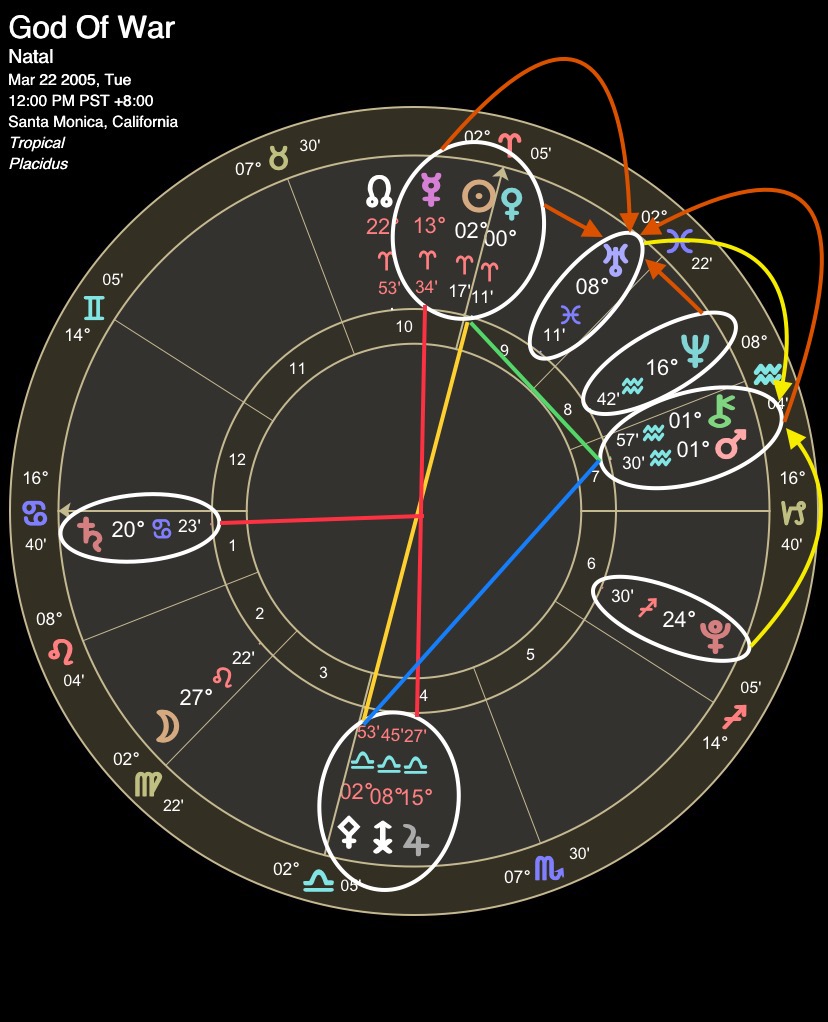
The most prominent dynamic is the Aries Stellium containing Sun, Venus, Mercury, and the North Node. This Stellium represents the influence of the god Ares. The fact that the main villain in this story aligns with this strong zodiacal expression is a crazy instance of synchronicity. The Sun’s conjunction to Venus is actually a super conjunction (aligned longitudinally and latitudinally) making it one of the most powerful aspects on the chart. Venus’ debilitated status (placed in the sign of its detriment) infers that the character associated with the zodiacal Aries may not be “good.” Specifically, it reflects a love of violence and combat. Also, the Sun’s prominence within any chart may be seen as a symbolical “god.” Basically, this super conjunction is the evil god Ares.
The opposition (yellow line) from Sun – Venus to the asteroids Pallas Athene and Zeus offers another strong correlation to the story. It reflects the confrontation between Ares and Athena through his attack on her temple as well as his ambitions against Zeus. The other opposition (red line) is connected to the only major configuration in the chart, the t-square. This t-square has a debilitated Saturn (placed in the sign of detriment) at the apex so it represents the focus of the energy. Saturn is about control, but when it is not in good shape it infers that the expression of that control is not moral, ethical, or just. It’s placement in Cancer symbolizes a lack of caring or nurturing. Here, Saturn has dictatorial aspirations.
With Aries’ connection to this configuration via Mercury we may conclude that Ares desires the evil drive that Saturn embodies. Mercury is retrograde and combust so the plans that Ares has are internalized and hidden out of view. This t-square represents Ares’ plans to take down the other gods (Jupiter) and become a dictator god (Saturn). But he needed help to pull it off…
The sextile aspect (green line) from Sun – Venus to Mars represents the assistance that Ares needed to pull off his plans. Mars is in the sign of Aquarius, a zodiacal symbol that is represented by a human being. Mars is the archetype of the warrior, so Ares’ helper is a human warrior. Mars is Kratos.
Because these bodies are connected by a supportive aspect and dispositorship (Mars rules Aries) is reflects the positive relationship that Ares and Kratos had initially. The problem is that Mars is also disposited by that evil Saturn. The expression of Saturn would eventually become a source of motivation for Mars and this highlights Saturn’s symbolic manifestation of its placement in Cancer – karma related to family issues. It is Kratos’ guilt from accidentally killing his family because of Ares’ secret plotting (Mercury). It is a constant source of grief that drives him (dispositorship).
It should also be noted that there are some who believe the sign of Cancer to be associated with the color white. This is fitting because it became a physical manifestation of Kratos’ appearance – a white complexion made up of his family’s ashes as karma for his deeds. This delineation of Mars’ dispositor sheds light on the partile conjunction to Chiron in Aquarius. This particular Chiron placement represents a type of wound due to feeling like the individual doesn’t belong to the group. In this story it is Kratos’ fate in becoming an outcast as the “Ghost of Sparta”.
Just how powerful is Mars’ rage in response to these dynamics? The midpoints provide some insight. Mars is tightly conjunct the midpoint of Uranus and Pluto. Uranus symbolizes revolution, change, and upheaval. Pluto represents painful karmic retribution and destruction. This is a midpoint of war. Uranus is also the modern ruler of Aquarius, so it’s massive conjunction to two other midpoints and six bodies confirms the other half of Mars’ motivation: to overthrow (Uranus dispositor) all the gods in order to get to Ares and avenge of his family (Saturn dispositor). Athena could see Ares for what he was (opposition) and knew that his over reach (t-square) had turned Kratos against him. Her support of Kratos was represented by the soft trine (blue line) aspect. Ultimately, the outcome of this story reflects the dispositorship of Mars to the Sun. Mars rules Aries, not the other way around. As a god, Ares critically underestimated this relationship and it cost him everything…and Mars (Kratos) became the true god of war.

 Electric Storm Astrology