
“Bohemian Rhapsody” is the epic rock opera masterpiece by the rock band, Queen. At the time, this song redefined what a rock song could be. It is not only on most short lists of greatest rock songs ever created, but also the short lists of greatest songs ever created, period. For a song with this type of cultural impact, it seems appropriate to evaluate the astrological dynamics associated with its release. The problem is that tracking down this astrological chart is not straight forward. The single was officially released on 10/31/75, but there is no documented time for this. Instead, we must default to the chart for the date and time that corresponds to its approximated first radio air play. But how do we find this? Well, there is a story to that.
During the month of October 1975, radio DJ Kenny Everett obtained/received an advance copy of the single. At the time, he was hosting a lunchtime slot on the weekends. When Everett received the tape, he was instructed not to play it, so of course he played it 14 times over the weekend. The reaction from fans was massive. They were scrambling to find the song the following Monday. Unfortunately, there is no record as to which weekend in October Everett initially played the song.
Astrological factors may provide some insight into these possibilities. The weekend prior to the official release was 10/25/75 – 10/26/75. On these dates, there was a tight conjunction between the Sun and Uranus in the sign of Scorpio. Given the bohemian flair of this ground breaking and revolutionary (Uranus) song, this astrological expression is an appropriate correlation. And if Everett played the song at his earliest opportunity (it was reported that he immediately loved it), then that would put the first airplay on Saturday, 10/25/75. Since Everett hosted a show around lunchtime then a chart starting around noon is probably not too far off from the initial air play. With a potential chart to explore, let us now do some more astro detective work to evaluate the degree of synchronicity.
Delineation Part One: The Events of the Release
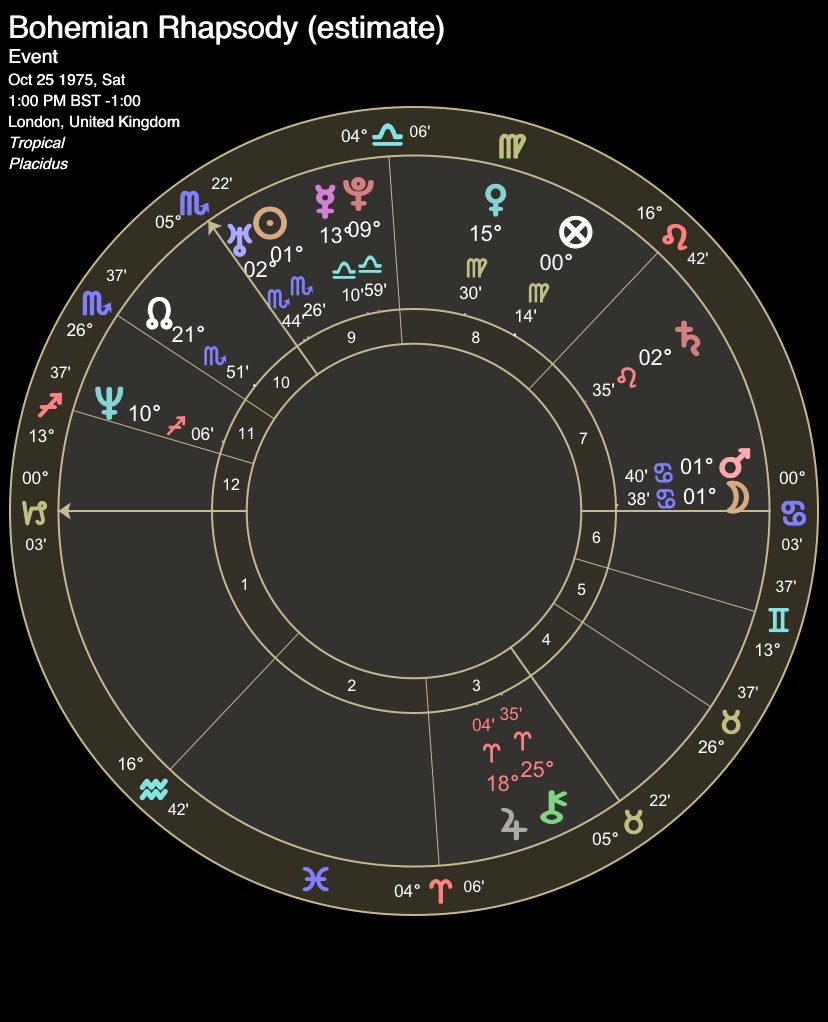
With a noon chart we have Sagittarius rising and Jupiter as chart ruler. Jupiter is retrograde and in the sign of Aries. The pioneering spirit of Aries might have some resonance for this moment, but the internalization of retrograde does not feel right, nor does Jupiter’s placement in the 3rd house of general communication and consciousness. What if the chart is moved forward one hour? With a 1:00 pm chat we obtain a Capricorn Ascendant. Wasn’t Everett a Capricorn? Why yes, he was. Saturn rules Capricorn and is in the 7th house of others. So, if Everett is represented by the 1st house, then who are these “others” in the 7th? Queen. If Everett is Saturn and Saturn is a gatekeeper and guard, but it is over there in Queen’s house then he is the gatekeeper for releasing their music to the rest of the world. What else is Saturn doing? It is making a square aspect to Sun and Uranus, the two bohemian bodies set to change the world with their radical creativity. And the Sun is the dispositor of Saturn. This means that the Sun is offering some influence. The Sun can be seen as an agent of creativity and it is aligned with the god of rule breaking, Uranus. This combination wants Saturn to break the rules. Given the rulership and the friction of the square, Saturn is going to do it. He is over there in the 7th house anyway. He wants to help them. As crazy as it sounds, Saturn is a gatekeeper who is going to break his rules on guarding the gate. He is going to play that single early even though he has been instructed not to.
With the Ascendant and chart ruler explained, let us look at the other side. Cancer is on the cusp of the 7th which makes the Moon the ruler of their house. Where is that Moon? It is placed in the sign of its rulership. It is dignified. That seems appropriate for a band that has named itself Queen. But it also speaks to the band’s talent and ability. Also, that Moon is in conjunction with Mars. Mars rules the 10th house of career. So that strong Moon in the 7th is a symbol of a talented rock band that was in control of their career trajectory. Mars disposits that Sun – Uranus conjunction as well. This means that the revolutionary creative product represented by those bodies is also owned by the band. As a matter of fact, the Moon – Mars combination is in tight trine aspect to the Sun – Uranus combination. This trine means that they will be highly effective in leveraging their talent to easily obtain success in selling this creative work to the public and establish their identity as innovators, experimenters, and progressive artist musicians. This trine between these four bodies practically ensured that the release of “Bohemian Rhapsody” would become an instant success.
Delineation Part Two: The Structure of the Song
In terms of the music, the Venus – Neptune square represents the otherworldly inspiration that went into creating this work of art. It should be noted that a rhapsody is an episodic, free flowing, yet integrated piece of music. The technical nature of Venus’ placement in Virgo and its connection to the boundary-blurring tendencies of Neptune are good reflections of this. Given that Freddie Mercury’s natal Sun was also in conjunction with this Venus, he was the driving force for the creative direction and layers of brilliant detail embedded within the song. As the Sun is the core of our identity, the creative structure of this song is also a reflection of Freddie’s.
The length of the song (almost 6 minutes) which was quite uncommon at the time, reflects Mercury’s opposition to Jupiter. Jupiter is in the 3rd house of lyrics and it has a story to tell (Mercury). Given Jupiter’s tendency to do things in a big way, this story is a big one.
Delineation Part Three: The Interpretation of the Lyrics
Despite the melodies and soaring symphonies of the music, the lyrical content is dark. Venus’ placement in the 8th house deals with some of the darker, more fatalistic themes. In some interpretations, the song is about individual who does not know if they are living in reality or their imagination and that their life makes no difference (“Any way the wind blows it doesn’t really matter to me”). This is the challenge and crisis of confusion and disillusion from the square to Neptune.
Upon this realization, the character decides to sell their soul to the devil. The 8th house has a connection to contracts and pacts, but this interpretation is more directly connected to Mercury’s mutual reception with Venus as well as its conjunction to Pluto, the god of power and the underworld.
Upon making this decision, the character rushes to their mother exclaiming, “I’ve just killed a man.” This man they have killed is themself (“But now I’ve gone and thrown it all away”) due to this existential crisis. This is another correlation to Venus’ placement in the house of death and crisis (square) with Neptune.
Neptune’s influence manifests into the operatic part of the song when the character finds themself in another reality and states, “I see a little silhouetto of a man” but then cries, “Thunderbolts and lightning, very, very frightening me.” There is a battle raging for this character’s soul and their mother pleads with the devil, “He’s just a poor boy from a poor family, spare him his life from this monstrosity!” This bargaining reflects Mercury’s conjunction to Pluto in Libra, impacted by its concern (mutual reception) to what is happening to Venus over in the 8th. The mother cries out repeatedly to “Bismillah,” which translates from Arabic to the “name of God.” Mercury is placed in the 9th house of God[i], so the mother is not only pleading with the god of the underworld (Beelzebub – aka Pluto), but she is also crying out to God as well. She is begging for repentance as well as begging to be saved. The power of the mother’s pleas is reflected again in the strength of the Moon. Here, the trine from that Moon to the Sun – Uranus Scorpio combo will be successful. It is interesting that the same strength of these astro dynamics that ensured the success of the song also more explicitly reflects the success of the mother in fighting for (Mars conjunction) and redeeming her child’s soul within the actual body of the song itself. Scorpio deals with rebirth and mother pulled it off and freed (Uranus) her child. This fight for redemption is an alternate delineation for the square between Venus (4th house ruler as well) and Neptune.
Uranus in Scorpio: Change & Transformation
While the song is much longer than many other songs of its day, its specific duration is noteworthy. At 5 minutes and 55 seconds, this duration highlights the repeating occurrence of “fiveness.” From a numerological perspective, the number 5 represents change and creative freedom. If “Bohemian Rhapsody” represents anything, it is the wild creative freedom and independence that went into its manifestation, but this iteration of 555 means something more just change. Some believe that the 555 is an angel number that enhances the archetypal significance of the number 5. The repeating occurrence of this number symbolizes the more enduring instance of change: transformation.
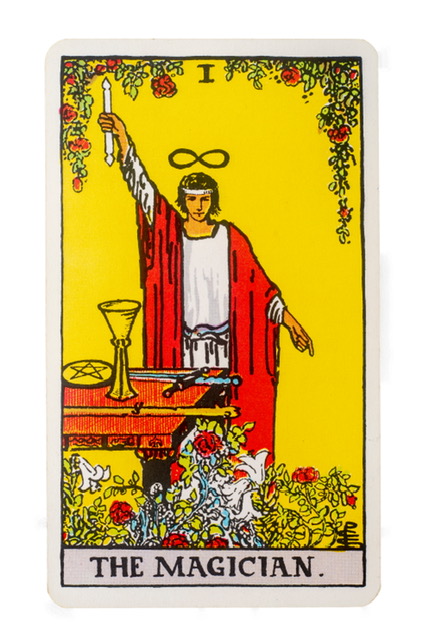
To understand this astrologically, we must return to Uranus in Scorpio because the archetypal dynamics of this planet are at the core of this chart and key to understanding the core of the song as well. Uranus’ transit through this sign occurred throughout half of the 1970’s and dipped a little into the early 1980’s. The alignment between the change that Uranus embodies filtered through the deeply permanent transformational lens of Scorpio have prompted some within the astrological community to wonder if Uranus has dignity by exaltation in this sign. This definitely bears consideration because its corresponding zeitgeist included the technological revolution with the rise of personal computers, the Iranian Revolution, the breakup of the Beatles, the death of Elvis, and the election of Ronald Reagan and the conservative revolution. While all these events indelibly changed us, one manifestation is especially significant: the Gay Liberation Movement. This was a prominently visible feature of the 1970’s and 1980’s and resonant for this analysis because many have interpreted “Bohemian Rhapsody” to be an artistic expression of Freddie Mercury coming out about his sexuality. This is the transformation that the 555 angel number infers. It is the transformation of identity that corresponds to the Sun – Uranus conjunction at the core of the chart, and it is the transformation highlighted in the metaphorical story of death, rebirth, and redemption told by 8th house Venus, Neptune, and the Mercury – Pluto conjunction. “Bohemian Rhapsody” is an enduring symbol of Uranus’ transit through the sign of Scorpio. The song IS this planetary archetype. This degree of alignment or synchronicity goes far beyond just a creative expression. This song is a type of magic that offers a listener to embrace radical transformation to gain the freedom to become who they truly are. Despite the alignment of Freddie Mercury’s energies to this song, if this overall synchronicity was intended then Queen were more than just brilliant musicians. They were magicians.

[i] With the 1:00 pm time Mercury is in the 9th house, but with a 2:00 pm time Mercury is in the 8th house and Sun – Uranus is more prominently featured within the middle of the 9th. These correlations make an argument for an even later time for the initial air play of this song, but I am defaulting to the earliest time that appears to make sense here. Unfortunately, we do not have any evidence or correlations that hint at the precise minute between 1:00 and 2:00 it occurred. Regardless, with either time we do not lose the 9th house themes that correlate to the interpretation of the song.
 Electric Storm Astrology