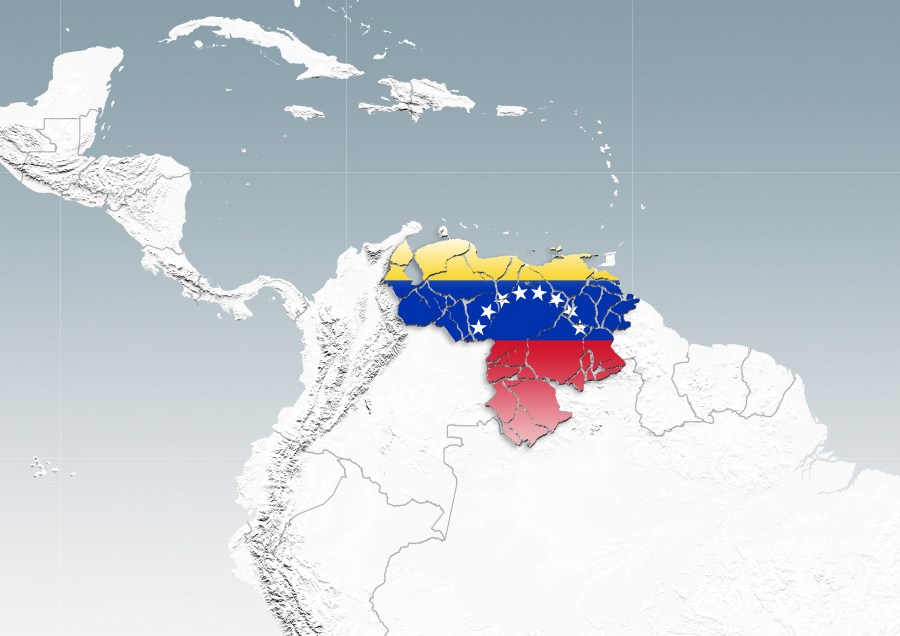
Over the past decade, the country of Venezuela has devolved into one of biggest humanitarian dumpster fires in the world. From 2017 – 2021, over 90% of the population was living in poverty. As of 2023, there are almost 8 million refugees in exodus. It is a total economic disaster and nothing short than a complete collapse of a country. This crisis has been in the making for decades and there are numerous issues at its core. Let us briefly review some of factors and circumstances that are known to have contributed to this mess.
The Crisis: A Synopsis
To grasp what is happening in Venezuela we need to first understand that this country’s economy is heavily dependent upon oil production and revenue. Venezuela’s state-owned oil and natural gas company contains the largest oil reserves in the word. So, when oil prices spiked in the early 2000’s, then President Hugo Chavez leveraged this to develop and fund multiple social programs to help the disadvantaged gain access to healthcare, affordable food, and literacy. While these programs resulted in massive government spending, they also saw some success. In its early days, poverty and unemployment were cut in half while per capital income doubled. The problem was that Venezuela had essentially “put all its eggs in one basket” with its oil revenues, so when prices starting dropping around 2013-2015 due to oversupply then they had no way to cover the costs of these programs.
Chavez died in 2013 and his successor Nicolas Maduro inherited this mess, but he made little changes in the historic policies and practices. By 2014, Venezuela had entered a recession. By November 2016, the country was experiencing the highest inflation in its history. These factors then led to massive shortages in food and supplies. As a result of these shortages, millions began fleeing the country. To get an idea of how bad things are, it should be noted that many have categorized this economic crisis as worse than the Great Depression that hit the United States in the 1920’s and 1930’s.
As the crisis deepened, the Maduro administration tried to deny its existence. They continued the high spending even as oil revenues plummeted. Worse, the administration was also accused of executing critics, protestors, and oppositional members without any type of due process. Instead of embracing the will of the people, Maduro’s government adopted an authoritarian position and effectively negated various democratic processes that would have allowed for change. In response to this abuse of power, there have been numerous large protests, but none larger than one in 2017 when around six million Venezuelans protested the Maduro administration. Their plan was to overwhelm Caracas (the capital). Numerous individuals and national guard were killed in the protests that escalated into riots in the following days.
As you can tell, this is a perfect storm of ego, hubris, lack of fiscal discipline, mismanagement, disorganization, and a lack of vision and planning. All of this is exacerbated by extreme abuses of power and corruption. Many right-wing pundits have latched on to this situation as a referendum to condemn all left leaning perspectives. According to them, left wing ideology leads to socialism which then leads to the Venezuela crisis. People from the other side of the political spectrum have rebutted this as opportunistic and simplistic thinking and stated that the debacle in Venezuela is more a reflection of general incompetence and malfeasance that would a symptom of any failing economic system, not just a reflection of the system itself. While these types of “back and forth” responses are typical in the aftermath of a crisis like this, they fail to consider one critical factor: the astrological chart of the country.
Venezuela’s Astrological Chart
As strange as it may sound, astrological charts do not only apply to living human beings, but to countries and groups as well. These types of charts are known as mundane charts and usually correspond to the moment that a country becomes an independent and sovereign entity. There are numerous ways to identify this criterion, but a proclamation of independence can be a good indicator of this moment. With Venezuela this was identified as the date the country declared its independence from Spain on July 5, 1811. Historically, the exact time for this moment was unknown, but recent research has placed this moment at 3:00 pm. The chart is below.
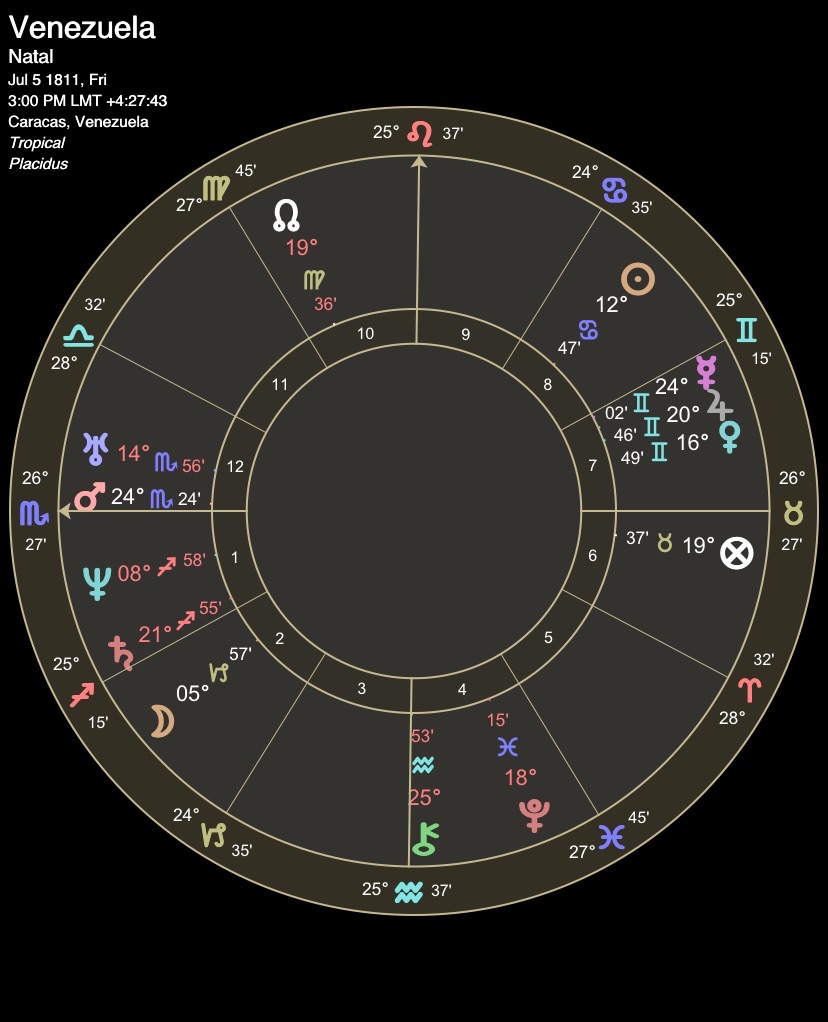
By defaulting to the quadrant style Placidus house system, there are three major features with this chart that correspond with the identity of the country as well as its current crisis.
Neptune in the 1st House
Neptune is natural significator for oil, so this planet’s placement in the 1st house of identity makes sense. Venezuela’s national identity is defined by its oil reserves. It should also be noted that this planet is placed within the 2nd house of resources in the Whole Sign house system. This means that oil is not just a part of Venezuela’s identity. It is how they make money as well.
Full Moon in the 2nd & 8th Houses
A Full Moon always has the potential to introduce some degree of instability, so its presence in the areas of life governing finances, resources, shared resources, and debt is particularly problematic. It is symbolic of the balancing act that this country’s economy has experienced repeatedly throughout its history. In any mundane chart the Moon represents the general population, the people. With the Moon debilitated in the sign of Capricorn, the population is not in good shape. Its placement in the 2nd house adds an additional layer of specificity: this debilitation is poverty. This correlates to reality because Venezuela has been historically recognized as one of the poorest counties in South America. On the other end of this opposition is the Sun who can see the dire condition of the people. The Sun is the country’s leaders. Its position in Cancer and dispositorship by the Moon reflects their concern for the people and motivation to do something to take care of them. With its placement in the 8th of shared resources, they intend on using the resources of the nationalized oil companies to try to help them.
The Pluto T-Square
This major configuration is ground zero for many of the issues. With Pluto at the apex and in the sign of Pisces there is a strong motivation to transform the country through a more empathetic approach. The square from Saturn to Pluto reflects the extreme level of hardship that is part of everyday life. To understand the underlying motivations of Saturn and Pluto we look to their dispositor, Jupiter. Jupiter in Gemini, the ruler of the 2nd house, and is also a part of this t-square and in conjunction with 8th ruler, Mercury. This means that social programs funded by the shared resources of the country is a major source that powers Pluto’s goals to bring about structural transformation. Jupiter’s involvement reflects the overspending that would occur to pull this off.
Saturn’s copresence with Neptune and alignment with the cusp of the 2nd house reflects how the oil companies were nationalized and its revenue was controlled to assist with these efforts. This t-square represents a massive push to overhaul the country using socialistic theories and mechanisms.
The problem is that Pluto represents archetypal forces that are extremely difficult to manage. For one, Pluto symbolizes power in all its forms. This can include any number of devious activities one may resort to in order to maintain power.1 With Pluto driving the manifestation of this t-square these problematic manifestations must also be considered, especially because it is also aligned with the South Node. The South Node represents a point where energies can be overused or over relied upon. Some view this to be a karmic placement for Pluto because it signifies a need to use power properly. From Venezuela’s recent history, this country has not learned this lesson. While the country tried to use this power to transform itself, when the oil revenues started to disappear then they began relying on Pluto’s more problematic manifestations: subverting democracy, rampant corruption, silencing and even killing protestors. The dictatorial style that Maduro’s government eventually adopted is a stark reflection of Pluto’s prominent position at the t-square apex, at the South Node, and in square aspect to Saturn.
Finally, because Pluto is placed in the sensitive 4th house of foundations and beginnings, all of these characteristics are at the core of the country. They are based upon them. This is what a “house of cards” looks like in an astrological chart.
Timing of the Crisis
Oil revenue was at the foundation of this house of cards, so the timing of this crisis coincides with the fall of oil prices. Prices started to drop around 2012, but the steepest decline occurred in July 2014.

The astrological tremors that corresponded with the beginnings of this crisis was the epic transiting Uranus – Pluto square of 2012. Most notably, this powerful alignment corresponded with massive protests from Egypt, Occupy Wall Street and Black Lives Matter. Unfortunately, Venezuela was ground zero for this astrological event because it aligned with the natal Full Moon in the country’s chart. The price tag for Chavez’s over spending on social programs was about to come due and the disruption to the economy would destabilize the country. At the month of the steepest drop (July 2014), transit Pluto was retrograding in an almost exact opposition to natal Sun. This was the recession, sky rocketing debt, and shortages. But this was not the end of it. The following year (2015), transit Neptune also went into square aspect with natal Neptune. This square is a milestone event in the lives of most human beings and corresponds with the midlife crisis. This crisis of disillusionment was more specific for Venezuela. It was a disillusionment because of collapsing oil prices and the sobering realization that the country had made a mistake basing its financial future on this one area. This square coming on the heels of the impact from Uranus – Pluto was devastating. These two major astrological events collapsed the country. But it was not over. In the wake of these events, transit Saturn ingressed into Venezuela’s 1st house while transit Chiron was still in conjunction with natal Pluto. These two events corresponded with the shortages and scarcity, the lock down from authority, and the massive abuses of power. In the aftermath of the destruction from Uranus – Pluto and Neptune, Saturn and Chiron forced leadership into desperation and they became tyrannical. Ultimately, these transits unleashed destruction upon the country and revealed the worst parts of the country’s astrological chart.
Economic Theory & Astrology
So, what lessons do we take away from this debacle? Again, the right-wing pundits view this as a referendum on socialism. They may not be wrong. Hugo Chavez was a big fan of Karl Marx and implemented some of the most aggressive socialistic programs. But we need to ask ourselves, would this crisis have occurred if the events unleashed by Uranus – Pluto and Neptune had not happened? Also, would any economic system have survived this onslaught of astrological energy if the chart for the country was similarly structured? If the answers to these questions are “no” then the economic system may not be the root cause of this crisis. While the country’s astrological chart reflected strong leanings toward socialism, it also contained many risks that were dependent upon on how it was managed. If Venezuela had relied on the advice of an astrologer, they could have been warned of the those risks along with the timing of what was coming. An astrologer could have advised Chavez that the successes the country was experiencing under his leadership would be short lived. Analyzing Venezuela’s crisis through the lens of astrology leads us to wonder if any economic system can ever be properly evaluated without also considering the chart of the country in which it exists. For example, many are harshly critical of capitalism as a viable economic system because of dysfunctional experiences with the Plutocracy within the United States. But would this Plutocracy exist if the United States did not have Pluto in the 2nd house and in opposition to 7th ruler, Mercury? And if it did not exist, would we have a different experience of capitalism? In other words, if we are to question whether Venezuela’s crisis is more of a reflection of the country’s chart then it is fair to consider the extent to which the economic system maintained by the United States reflects its chart as well. All of this suggests that any economic theory can never be truly divorced from the astrology that interacts with it. Which also means that no economic theory is inherently “wrong” if it is evaluated separately from the astrological characteristics that shape it from behind the scenes. Politics governs our existence, and yet, politics is just a struggle to find the most effective system in distributing money. If we have ignored a critical factor that underlies the effectiveness of those theories/systems, then that also infers that the blind spot in how we see the world is massive.
End Notes
- Mars in Scorpio rising at the Ascendant could also be emblematic of the corruption that became synonymous with the Venezuela’s identity (1st house). The connection to Pluto via modern rulership (Pluto rules Scorpio) is one reason for this. Mars in Scorpio was also prominent is the massive protest on April 19, 2017 when it was at the apex of a Yod configuration with transit Uranus and natal Mercury with transit Mars at the opposing activation point. This alignment manifested as the uprising from the general population due to their anger at the Maduro government. ↩︎
 Electric Storm Astrology