Dashrath Manjhi was a poor laborer who worked on a farm near his small Indian village of Gehlaur in the early 20th century. Nearby his village was a mountain that prevented easy passage to the urban medical facilities on the other side. To get there, the villagers were forced to travel 70 kilometers (43.5 miles) around the mountain.
One day while Manjhi was working, his pregnant wife decided to trek up the mountain to bring him food and water. This moment that would change his life forever. She slipped and fell down the mountain. By the time Manjhi found her she was still alive, but time was of the essence. She needed medical care immediately, but this was not possible. The mountain was in the way. Manjhi tried to transport her around the mountain, but she did not make it. Miraculously, the baby survived, but he was now a single father. This event would have crushed most people, but Manjhi was not like most people. Instead, this event filled him with a steely resolve. Years later, one of his children went on record quoting their late father:
“He would tell the villagers that this mountain existed right since the earth came into existence and when this mountain made my wife cry and ultimately killed her, I don’t know how many wives would have suffered from it in all the past three Yugas but now none will feel the pain anymore as I will remove the obstacle forever.”
Over the next 22 years Manjhi worked every night after finishing his main work for the day and attacked the mountain with a hammer and chisel until he had accomplished the impossible: he carved a path through the mountain 360 feet long, 25 feet deep, and 30 feet wide. This path shortened the distance to medical facilities to just one kilometer (roughly half a mile). This mountain had not beaten him. It had given him purpose. It had given him a goal. And after beating this adversary, the rest of the country recognized his heroic efforts as well. They renamed him. Manjhi was immortalized as the “Mountain Man.” This simple poor farm laborer had elevated into mythology.
So how the heck did Manjhi possess this type of power? What was so special about him that it empowered him to literally move a mountain? One of the best places to look for insight into these questions is Manjhi’s astrological chart. For it is this chart that reflects a unique alignment of energies that explains everything.

Triple Capricorn
Unfortunately, there is no reported birth time available for Manjhi. In these scenarios, a time can still be deduced through a process called rectification. Usually, rectification requires a list of significant events (around 10-15) in the life of the individual along with their corresponding dates. The astrologer then works backwards, analyzing the planetary positions for each date in order to identify the potential angles of a natal chart. We do not have a list of events for Manjhi, but there may be a way to deduce a general time frame anyway. The reason that this may be possible is due to the significance of the event. The death of his wife was a horrific event that transformed him and gave him purpose. And it is a little secret that rectification tends to work best with those events that are the worst. So, let us take a second to understand this event a bit deeper.
Again, it has been reported that Manjhi’s wife died while being transported around the mountain to the hospital. This means that Manjhi was there at her final moments. Was he holding her? Did he tell her he loved her as she passed? It has also been reported that the baby survived. Did Manjhi deliver the baby on the road from his dead wife’s body? Or did he continue to transport her body to the hospital where they delivered it? And what was he feeling holding a newborn after watching his wife leave him permanently? The most important person in his world was gone and he now must raise this baby alone. Think about how that moment must have felt. If it seems sadistic to drag you through this exposition, there is a reason for this because this is what Pluto feels like. Pluto introduces life and death struggles into our lives that makes us question our identity, mortality, and existence…and Manjhi was born with Pluto in opposition to his Sun. There was the potential that he would encounter this horrific experience at some point in his life. This event was that. It shaped who he would become permanently. It transformed him.
Given the correlation between this natal aspect and that event, we then must question which house polarity was this opposition located. If this transformational event involves the death of his wife, then we must realistically consider that the 7th house was involved because this is the area of life where we find our marriage partners. And given what we already covered with Pluto; it is probably placed there as well.
And with Pluto placed on the 7th house then this also places the Moon in Capricorn and in the 12th house. This is significant because the Moon would then be the ruler of the 7th house. The Moon is debilitated in Capricorn and the 12th house is an area of life that includes suffering. It is where things become lost to us. It is where we mourn. The Moon symbolized Manjhi’s wife who became lost to him. As the significator for the emotions, this loss defined his emotional state. He may have tried to hide it within the 12th and under a stoic armor of Capricorn, but I would imagine that most days he felt lost without her.
Of course, if the Moon is in Capricorn and the 12th, then the ascendant is in Capricorn as well. In other words, Manjhi was a triple Capricorn. This sign was not just his core sense of self (via the Sun), but also the primary shared expression of the three most prominent components of his chart. So, what do we know about this zodiacal expression? In its purest, rawest form, Capricorns are some of the most goal oriented, achievement driven, and hard-working qualities. They can be extremely persistent and disciplined. But to evaluate the sign’s motivation, we must also evaluate the characteristics of Saturn since it rules Capricorn. In this regard, Saturn holds a unique prominence for Manjhi because it is the natural significator of mountains. The death of his wife via Pluto, his mourning of her via the 7th ruler in the 12th, and his Capricorn energies were left with nothing but the presence of this giant enemy looming over him. With Saturn’s placement within the 2nd house and the derived 8th from the 7th house (death of spouse), Manjhi knew that the mountain had killed his wife. With Saturn’s placement in Aquarius, he also knew that this mountain would eventually kill others as well. But with Saturn’s alignment to the North Node of life purpose, he also knew that this mountain was his purpose. Saturn had given Capricorn its goal and the Sun’s transformation via Pluto would now take on a literal manifestation. He would take down that mountain and, in the process, transform his identity (1st house Capricorn energies). Ultimately, these overall dynamics point to a chart (chart 1) that is based around a birth time somewhere close to 6:45 am.[i]
The Grand Cross
But believe it or not, Manjhi would still need more to pull off this mammoth task. He would find this through the grand cross configuration involving his Sun – Pluto and Uranus – Jupiter. Grand crosses are massive configurations of hard aspects that produce an overwhelming amount of internal friction, stress, and frustration within the individual. For some, it can compel and motivate them to almost super human levels of manifestation. For Manjhi, the death of his wife (7th house Pluto) had empowered him (1st house Sun) to improve the access of his local community (3rd house Uranus) so they could travel outside to other villages and towns (9th house Jupiter). These were his problems and through the grand cross he felt them continuously. This overwhelming frustration became the fuel that powered his unstoppable Capricorn expression and allowed him to work every night.
At the time of his wife’s death, this grand cross of stress had aligned by solar arc with Manjhi’s nodal axis (chart 2).[ii] Transit Uranus was also moving through his 7th house (spouses, marriage partners) and aligning with that nodal axis as well. Uranus’ archetypal dynamic for chaos combined with solar grand cross manifesting as the accident that killed his wife. Transit Saturn’s conjunction to his 12th house Moon symbolizes the heaviness of his emotional grief as well as the literal symbolism of the mountain’s involvement in this event.

Additionally, Saturn had tightened its conjunction to his North Node by around half a degree by secondary progression. This slow-moving progression remained in conjunction for the ensuing 22 years. By the time of his completion in 1982, Saturn was 2° degrees waning in its conjunction to that North Node, just enough to be considered out of orb by secondary progression (chart 3).
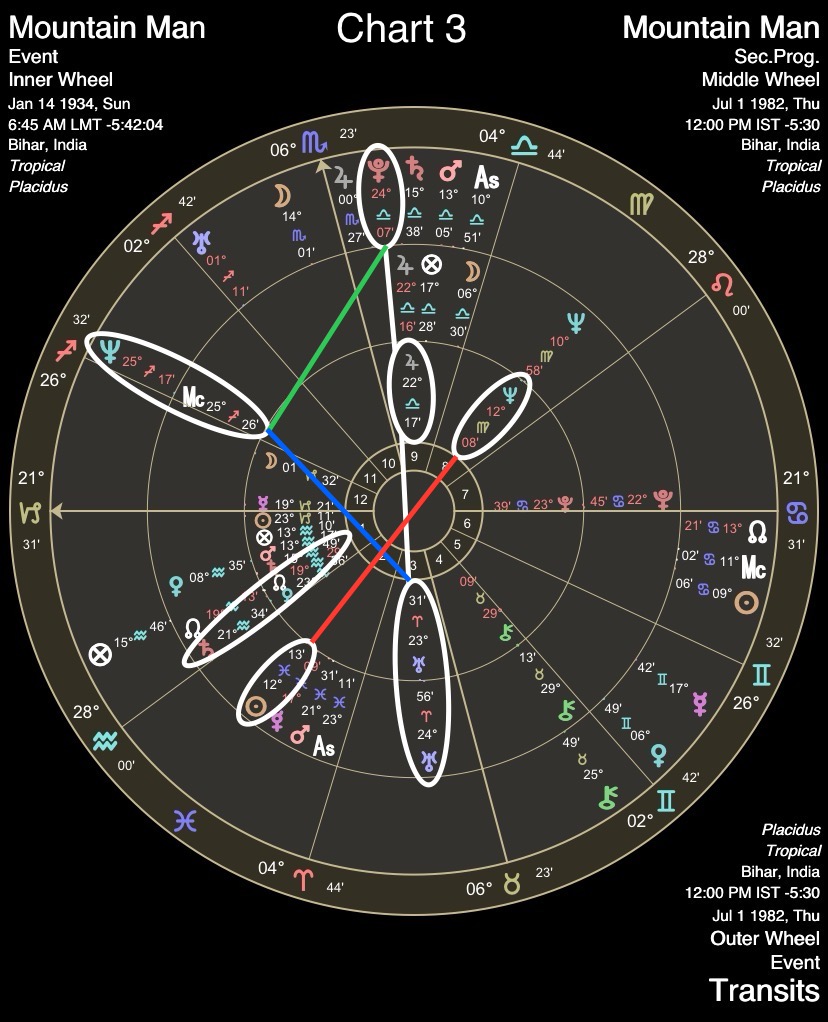
Also, transit Pluto had aligned with his Jupiter – Uranus polarity, finishing the job in taking down the mountain and transforming transportation for his neighbors and villagers. Finally, transit Neptune was in conjunction with secondary progressed midheaven and aspected both ends of his Uranus – Jupiter polarity while secondary progressed Sun was in opposition to his Neptune. These alignments manifested as the ultimate recognition of Manjhi’s great work. He had become famous. An icon whose story had transcended into mythology.

[i] I would not recommend doing a formal rectification in this manner. So, this chart should viewed with some degree of skepticism. If a credible list of significant life events with dates is confirmed then I will perform a comprehensive rectification to see how well this chart holds up.
[ii] All dates were anchored to the middle of the year due to the fact no exact date was confirmed for any of the major events. For the purposes of timing, the movement of the slower moving planets are still resonant with this estimate.
 Electric Storm Astrology